




ECB vs Fed vs BoJ: The Great Policy Divergence of 2026

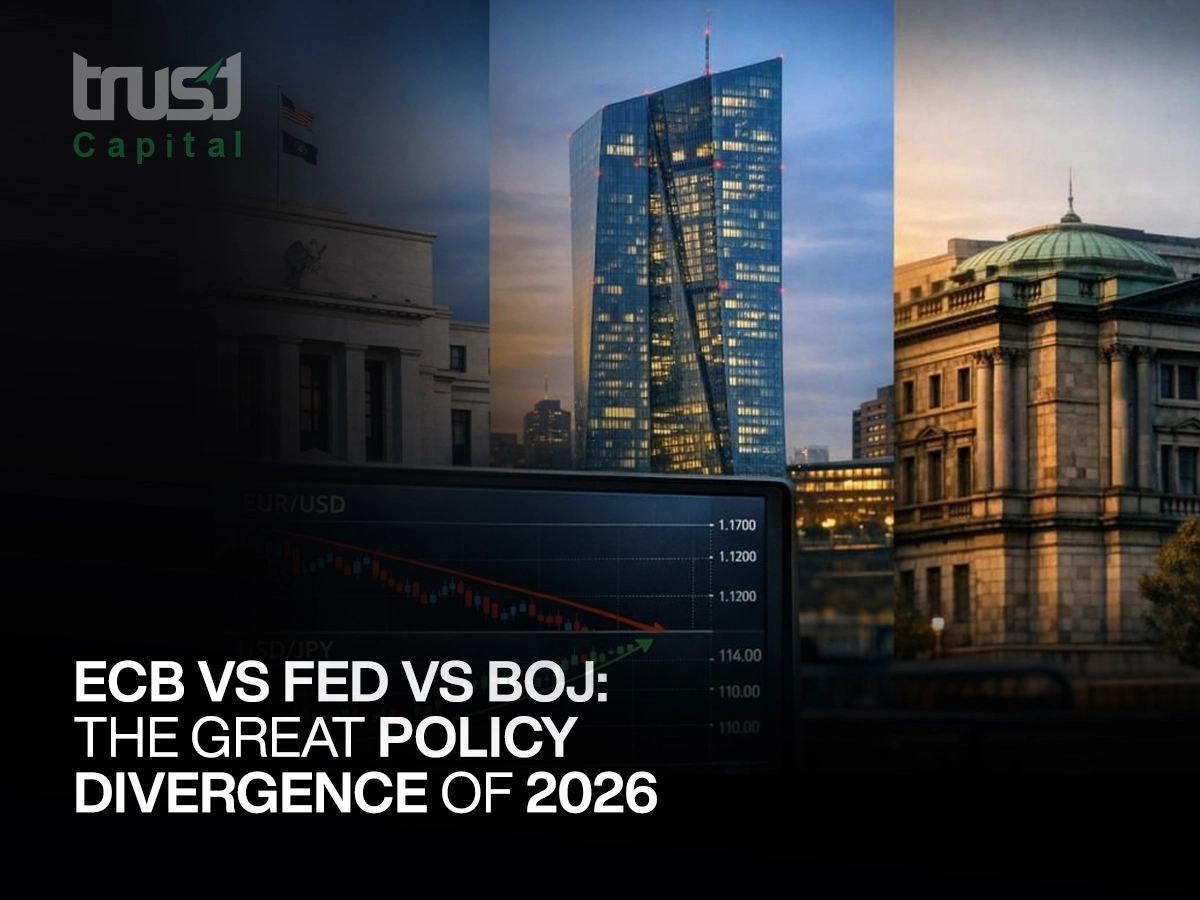
The global monetary landscape in 2026 is unlike anything seen since the early 1990s. Three of the world's most powerful central banks the European Central Bank (ECB), the US Federal Reserve (Fed), and the Bank of Japan (BoJ) are charting radically different courses. For traders and investors in the UAE and beyond, understanding this policy divergence is not just academic. It is the single most important macro driver shaping forex pairs, equity valuations, and commodity prices right now.
Where Each Central Bank Stands Today
As of mid-June 2026, the three institutions find themselves in strikingly different positions:
The Federal Reserve entered 2026 having already cut rates by 175 basis points from its 2023 peak, placing it close to a neutral policy stance. However, a stubborn combination of sticky inflation, softening employment, and geopolitical disruption from the Hormuz oil shock has effectively paralysed further action. Internal divisions at the Fed are at their deepest in decades, with reported 4-to-8 dissents at recent meetings. Markets are pricing in a prolonged hold, with rate cuts pushed well into late 2026 at the earliest.
The European Central Bank has taken a more hawkish turn. After five consecutive cuts since June 2024, rising energy prices driven by the Hormuz crisis have pushed eurozone inflation back above target. The ECB, led by Christine Lagarde, has responded by pivoting back to hiking, making it the only major central bank actively raising rates in this cycle. Markets are now debating whether a September follow-up hike is warranted, with EUR/USD reacting to every Lagarde press conference.
The Bank of Japan presents the most nuanced picture. Having spent three decades trapped in ultra-loose policy, the BoJ finally began normalising rates in 2024 and conducted two additional hikes in 2025. However, higher import costs from the oil shock are beginning to drag on Japanese growth, and Governor Kazuo Ueda has struck a cautious tone. A potential hike remains on the table not necessarily to fight inflation, but to defend the yen, which has come under renewed pressure.
Why Divergence Matters for Traders

Central bank policy divergence is the engine behind major forex trends. When two central banks move in opposite directions one hiking, one holding capital flows toward the higher-yielding currency, creating clear directional momentum in currency pairs. This dynamic is playing out sharply across three key pairs right now:
EUR/USD: The ECB hiking while the Fed holds has shifted the structural driver from US rates to European growth. EUR/USD has room to move higher if eurozone data surprises positively, but range-bound trading is equally likely if energy costs dampen growth momentum. Watch for structural breaks above key quarterly resistance levels.
USD/JPY: This remains the most event-sensitive major pair. Every BoJ meeting carries the potential for sharp repricing. A surprise hike especially one framed around yen defence could trigger a rapid unwind of carry trades that have built up significantly. USD/JPY could see 200–300 pip moves on a single BoJ statement.
EUR/JPY: Often overlooked, this cross captures the full spread of the divergence story. An ECB hike combined with BoJ caution could push EUR/JPY to multi-year highs, offering trending opportunities for momentum traders.
The Hormuz Factor: Reshaping All Policy Assumptions
No analysis of 2026 monetary policy is complete without acknowledging the Hormuz oil shock, which has fractured the global consensus that was building around a gentle, coordinated easing cycle. By pushing energy prices sharply higher, it has rekindled inflation fears in Europe and Japan while simultaneously threatening growth across all major economies.
This creates a genuine policy dilemma: central banks that were on a clear easing path now face inflation risks that demand restraint, while growth risks demand stimulus. The ECB has chosen to prioritise inflation, hence the pivot to hiking. The Fed has chosen paralysis, acknowledging that neither cutting nor hiking feels safe. The BoJ is weighing whether inflation or growth deserves the bigger concern.
The result is the most fragmented major central bank environment since the early 1990s, a period that ended with the European Exchange Rate Mechanism (ERM) crisis and a decade of Japanese stagnation. History does not repeat, but it rhymes.

What This Means for UAE-Based Investors and Traders
For clients trading with Trust Capital, the 2026 policy divergence environment presents both opportunity and risk. The elevated volatility in forex markets, particularly in EUR/USD, USD/JPY, and EUR/JPY, creates meaningful intraday and swing trading setups. Gold, which has historically benefited from uncertainty and a weaker dollar, remains a key watch given Fed paralysis.
Equity markets are also affected. US tech stocks that rallied on Fed easing expectations now face a valuation reassessment if rate cuts continue to be delayed. European equities carry the dual weight of ECB hawkishness and energy cost pressures. Japanese equities offer selective opportunities, particularly in export-driven sectors that benefit from a weaker yen — provided the BoJ does not move aggressively.
Diversification and disciplined risk management have never been more important. In a world where five major central banks can reach five different conclusions about the same global shock, correlation assumptions built during the synchronised easing era of 2024 are now dangerous.
Conclusion
The great central bank divergence of 2026 is not a temporary blip. It reflects genuinely different economic conditions, different inflation profiles, and different political pressures across the US, Europe, and Japan. For traders and investors who understand the mechanics, this divergence is a source of alpha-generating opportunity. For those who ignore it, it is a source of unexpected and painful volatility.


